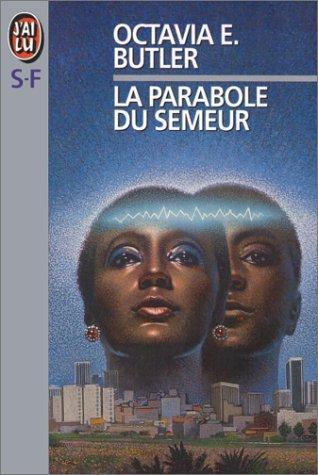
La parabole du semeur

, #1

mass market paperback, 382 pages

Langue : French

Publié 7 novembre 1995 par J'ai Lu.

ISBN :
978-2-277-23948-2
ISBN copié !
Numéro OCLC :
406770029

Voir sur OpenLibrary

Voir sur Inventaire

Parable of the Sower is a 1993 science fiction novel by American writer Octavia E. Butler. It is a post-apocalyptic science fiction novel that provides commentary on climate change and social inequality. The novel follows Lauren Olamina, a young woman who can feel the pain of others and becomes displaced from her home. Several characters from various walks of life join her on her journey north and learn of a religion she has crafted titled Earthseed. In this religion, the destiny for believers is to inhabit other planets. Parable of the Sower was the winner of multiple awards, including the 1994 New York Times Notable Book of the Year, and has been adapted into a concert and a graphic novel. Parable of the Sower has influenced music and essays on social justice. In 2021, it was picked by readers of the New York Times as the top science fiction nomination …

6 éditions

A brilliant book

I'm fascinated by shows such as "The Walking Dead" and the BBC's 2008 "Survivors," which is about the small fraction of the population who remain after a man-made virus wipes out 99.9 percent of humanity. These shows create circumstances favorable to psychopaths (he who kills without hesitation has an advantage over anyone with a conscience), and put good people in the position of having to decide how best to use force in order to stay alive without killing their own humanity.

The Parable of the Sower is in a similar vein, but it's more realistic than the two shows I mentioned. There's no pandemic and no zombies. The "big bad" is a societal collapse in the US caused by climate change and corrupt and inept government. Society has become stratified into the super-rich, who we never see in the novel, except for a mention of them flying around in …

finally a post-apocalyptic story that says something meaningful

The best "post-apocalyptic" story I've ever come across. So good, it puts most of the others to shame. Also just a great story on its about community, religion, and how to believe in and work for a better world. I wish it was recommended reading in school.

This felt like it was published last year

Which feels like a cheesy thing to say in a review about dystopian fiction, but I genuinely didn't realize this book was published in the year 1993 until I read Butler's biography at the back and realized she passed away in 2006. It feels... pertinent

Others have said this is a pretty grim novel. I agree. It hurt to read, quite often. I feel like I've mostly moved out of my dystopian fiction era but this one hooked me a lot harder than most I've read. I haven't finished a book this quickly in quite a while.

I think Parable of the Sower has a lot to say about eco-fatalism, as well as the many "fatalisms" of neoliberalism in general, which it delivers on very well. I also felt like it would have a lot to say about the value of religion, divorced from the way people in …

a publié une critique de Parable Of The Sower par Octavia E. Butler

am I not getting this?

maybe I was expecting too much because I'd heard about it in adrienne maree brown and Autumn Brown's podcast and thought this was going to be extremely mind-blowing. I kept expecting the story to go somewhere, to develop in some direction but it just kept being a bleak, lost earth and people trying to just survive on it. seemed to me like the plot just fizzled out.

a publié une critique de Parable Of The Sower par Octavia E. Butler

Aucune note

Cuando estaba más joven la ficción y la ciencia ficción eran espacios que me hacían sentido para conectar con la imaginación y con la posibilidad de pensar y sentir la vida fuera de límites que percibía en mis presentes.

Como estos ámbitos de la literatura no resonaban tanto en algunas de mis redes cercanas, me alejé un poquito de éstos por algunos años y me metí a libros más teóricos y "serios". Pero desde que empecé a leer a Octavia Butler, por recomendación de una amiga, volví a interesarme en textos de (ciencia) ficción.

Octavia reflexionó sobre la ausencia/invisibilización de mujeres negras en un contexto donde predominaba una ciencia ficción de escritores hombres y blancos. También propuso escenarios que abordaran los pasados-presentes-futuros y que estimularan la imaginación y la creatividad como posibilidades ante las crisis que seguimos viviendo.

En Parable of the sower, Octavia tejió temas como: …

The government is useless and we're all gonna get raped and our houses burned down

Both right-wing and left-wing preppers will find something for them in this book. Written from the POV of a teenager in a life-or-death situation, the book is pretty much on survival mode the entire time, with the accompanying lack of nuance and fear permeating throughout. Still, seems like an important and balanced read.

Review of 'Parable of the Sower' on 'Goodreads'

Aucune note

I did not feel invested in any of the characters, but I did find them, their stories, and the setting very interesting. In that way I feel conflicted about this book. Another thing is that I was always expecting things to get worse in the next chapter, as the protagonist realizes early on, so I was anxious about continuing before I would read each time. But because I didn't feel invested in the characters, as shocking as the events were I wasn't too bothered by them.

Review of 'Parable of the Sower' on 'Goodreads'

On a second read, I feel a lot differently than I did the first time around. I can't separate uncomfortable feelings of reading about a teenager basically starting a cult and attracting people who are at their absolute most vulnerable to join. It doesn't sit well with me to read about Lauren's glee to "raise babies in Earthseed." And the intense, intense, dehumanization and otherizing of people using drugs, making them into physically unrecognizable monsters, is something I can't get past. If Lauren has hyper-empathy, and is more sensitive to people in need of help, then why does the buck stop with people using drugs?